 It doesn’t matter what the format is, movie, TV show, video
game, painting, commercial for Senokot
effective constipation relief, once in a while something is created that
transcends the boundaries of what is expected of it; a game-changer. Take Wuthering Heights. Before Emily Brontë
got bored silly of being sat on her arse in Yorkshire, rolling corks about or
whatever she did for fun, and got round to writing, people did not write novels
like Wuthering Heights. If women
wrote novels it would be about ladies in high society farting around old manor
houses, giggling and blushing and generally being tedious; see Sense and Sensibility, Pride and Prejudice, ad nauseam. When Heights came along and portrayed a world
with a sort of hard-edged and cold brutality (there’s at least two instances of
puppies being hung. I know), it was beyond progressive. It was taking what was
expected of 19th century literature and totally flipped it on its
head; stories of petite virtuous young maidens were replaced by a grimy, dark, feckless
vision of cruelty. It took the rules of what a novel should be, and ignored
nearly all of them. Why am I talking
about Emily Brontë’s puppy-strangling masterpiece? Well, you would be right to
think I won’t be dwelling on it for much longer. We are talking about
innovation, and, from one innovator, we move to another innovator, a guy named
Ken Levine, and his studio, 2K Boston (now Irrational Games), and in a single sweep
that is neither consistent nor intuitive, we move to their (more literal) game-changer. Bioshock.
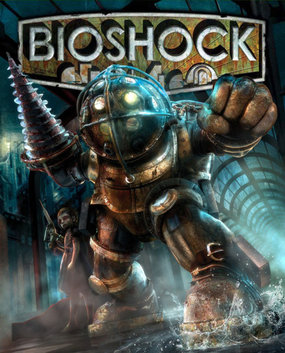
After a short cryptic monologue of your character Jack, sat aboard a transatlantic flight, and a brief blackout to the sound of screams and faltering rotor blades, Bioshock begins proper as you battle your way to the ocean surface, and emerge gasping for air among the burning remains of the crashed aeroplane. After swimming a little way round the fuselage you come across a huge lighthouse, solitary in the middle of the ocean. You haul yourself up the crooked steps, audibly gasping at the cold sea air. After entering the tower, and past a huge banner (‘No Gods or Kings, only Man’) and entering a little bathysphere, you are whisked downwards and underwater. As a tinny old welcome video whirs into life, you catch your first glance of Rapture, an underwater city, with a blue whale swimming lazily down its high street. At this moment that you just know, that this game is going to be something very special. It is incredible to think that this game was released in 2007, a full five years ago. Bioshock is a soaring triumph for atmosphere, storytelling, foreshadowing, characterisation, voice acting and solid scriptwriting; essentially, style. Bioshock draws on an absurdly wide range of references. Set in the 1960s, the height of cold war hysteria, Bioshock is the story of Andrew Ryan, an introverted billionaire genius, who, disgusted with the power-hungry philandering of America and the Soviet Union, along with the continued ambitions of the Church, rejects all of them, and begins to build a reprieve from these corrupting influences. I thought about doing this once too, thought it through, rang a couple of guys, but in the end realised that the amount of plumbers required to run a city totally underwater would scupper the budget , although another consideration was the possibility of floaters and associated blockage attaining lethality in the cramped environment.
‘It was not impossible to build Rapture’ muses Ryan, ‘It was impossible to build it anywhere else’. And he kind of has a point. Where are you truly free from state or religion? At the bottom of the Atlantic Ocean, apparently. Andrew Ryan was obviously taking notes when the talking crab said ‘Darling it’s better/ Down where it’s wetter/ Take it from me’. Having constructed his secluded metropolis, Ryan invites the top minds in science, the arts, medicine, and engineering to be left to pursue their fields away from the grasping hands of Big Government, and with the promise of a society without censorship or moral restraints. But of course, things don’t stay good for long. After discovering that sea-slugs secrete a substance that can modify genetic material (which, by the way, they totally do), the citizens of Rapture are introduced to Adam, a genetic material which gives them new and powerful abilities. More on them later. However with all the emphasis on the boffins, the workers in the city become restless and a rift open between the average Joes and the elite. This is exacerbated to the point of genetic warfare; just like the miners’ strike in the 1980s. By the time you turn up things aren’t so hot. Rapture has fallen into disrepair, the inhabitants, driven crazy by ‘splicing’ of Adam, are no longer so civilized, and attack you on sight. Rapture, as a setting, is incredible. A dilapidated art-deco metropolis, buildings separated by long glass corridors, through which you can see schools of fish swimming by and hazy neon lights obscured by the deep blue water. They say that in movies the director spends far more time lighting the scene than filming it, and the same is true here. So much work has gone into the look of Rapture, and it is teeming with nuances and subtleties. This is not a recreation of a real-world location; it is something totally exclusive to the game. You see posters for forthcoming movies, banners and posters proffering slogans that you recognise from the game characters, and Rapture’s own propaganda campaigns. The atmosphere, and the sense of place, is so powerful that it is almost tangible, the feeling of being isolated in this cramped under-sea madhouse. It is a totally unique experience.
Furthermore the splicers are a captivating enemy. Decked out in masquerade masks, and wearing tattered three piece suits, smeared in blood, they are an unsettling enemy, and sometimes darkly funny. One Splicer you find is looking dewy-eyed into a pram and whispering sweet-nothings to what you discover to be a handgun. A couple argue bitterly through a kitchen door, and then come flailing at you with some lead water pipes. Their constant babbling and in-fighting means you are never facing a foe that is totally sane. Then there are the Little Sisters. In what can only be described as one of the more unsettling characters ever put into motion, the Sisters are little girls with long syringes to squeeze juicy goodness out of dead bodies (what 8 year old wouldn’t want to do that?) Their shins are spattered in blood, and they have vacant, glowing eyes. It is so unbelievably creepy, but even they aren’t the real problem. The real problem is the Big Daddies, hulking great nasties in deep sea diving suits (the old, copper coloured, clunking sort). Sporting a three-foot drill for a right hand, they lumber about with the sisters on their backs. The big daddies, who you have to face if you want to get Adam (which, you do), provide some of the most memorable moments in the game, effectively boss-battles but executed in a much more fluid style. The daddies are placid, and will only attack if you hit first or provoke one of the sisters, meaning you can plan and prepare how you are going to tackle it, what tools to use and which plasmids you are going to try out. Planning is a necessity, since rather like librarians in public libraries, once angered, they never relent in their fury. Then, if you manage to get the better of Rosie, or Bouncer (these are genuinely their names), you are faced with either harvesting, or saving, the sister. While after the first occurrence this loses most of its moral traction, this is still a deeply arresting feature. You can either save the sister, returning her to childhood and innocence, or you can harvest them, leaving behind only a wriggling sea-worm. It’s at this point that you begin to wonder how the hell this game was even published.
The story is told largely through old cassette players, strewn throughout Rapture. They unravel the story of the troubles in Rapture and the different characters, many of whom you never actually meet, which is unnerving, like the part at the beginning of thriller movies where they find the deserted house with the kettle still boiling. There are still plenty of characters you do meet though. Your most immediate contact is Atlas, a mysterious Irishmen who leads you through the story, and becomes increasingly important to the plot in a way so expertly crafted that it doesn’t bear spoiling. All of Bioshock’s mythos is powered by the philosophy of Ayn Rand; a claim few video games can make. Namely Rand’s final novel, Atlas Shurgged, and her theory of Objectvisim, is mirrored in Andrew Ryan (pneumonics, anyone?) and his determination to ride Rapture of ‘the parasites’; the small minded, the cowardly, even the cautious. The Bioshock lore is a melting pot of atmosphere, storytelling, setting, and far-flung literary and philosophical inspiration. This is a game with a lot to show and a lot to say. But along with this style there is substance; alongside subtlety and nuance, there is epic and frenetic action. The shooting mechanics are razor sharp in this game, and back up the setting with hard-edged combat and fight sequences. There are weapons right out of the 50’s and 60s, revolvers, tommy-guns and shotguns, but they all have a sort of B-movie, Americana sci-fi facelift, thanks to the upgrade stations, giving outlandish but heavily effective mods to the guns. But beyond this there is the most important part of Bioshock’s combat system; plasmids. These give the player what are, to use a crass term, super powers. Based off of frequent Adam injections, they allow you to fire electric bolts from your hand, or ignite enemies in fire. These plasmids become more complex and wacky as the game progresses. Some cause the bad guys to turn on one another, or give you the ability to get the clunking big daddy on your side. Others turn your foes to ice, which you can then shatter with a few wrench swings, or allow you to send a swarm of angry hornets from your wrist, like some sort of honey-loving Spiderman.
These bring a crucial edge to combat, allowing you to combine them with bullet attack, and to manipulate to environment. Telekinesis plasmids allow you to pick up objects and fling them at attacking splicers. This provides some comedy gold. Nothing beats picking a fight with a big daddy by flinging a dead cat at his posterior as he clunks away down the corridor.The plasmids are backed up with various gene-tonics that can electrify your flesh, reduce damage you take, or enhance you in combat or the hacking system. There are various hackable objects through the game, and if you complete the workable, if not very exciting hacking mini-game (involving pipes ), then you can hack an item and get it on-side. These include turrets, and cutesy little helicopter robots, who when hacked, bob at your side and noisily bang and whistle whilst spraying enemies with machine-gun fire. The plasmid system allows you huge creativity whilst never leaving you over-powered, and a rush of angry splicers or a big daddy encounter can still bring you crashing down to earth. To cover everything worth mentioning in Bioshock would take a lot more space, of which I don’t have. But why spoil the surprise? This game is chock full of intrigue, as you tentatively wander through this deeply unsettling sunken ruin, teeming with angry, wrench flailing malcontents. This is a wide, tingling spider-web of betrayal, horror and suspense. There is plenty of parallels and pop culture references; see the disgraced cosmetic surgeon, driven mad by endless nose-jobs and face-lifts, decides to go all Picasso on his unwitting patients.
Sure, it is not a flawless experience. The vita-chamber system, whereby you respawn in a trendy glowing cupboard like something out of laser-quest, means you can wear down the game through repetition over skill, which can affect the experience. Plus you get a bail-out ending, with a standard, button-mashing ‘final boss’, and a closing cut scene that is beyond rushed. But these are trivial problems. The desolate city of Rapture is the most captivating environment to ever be committed to disk, a failed dream with an interesting story to tell. Everything from the excellent voice acting, the inspired plot twists and turns, the dank, frightening atmosphere, the soundtrack, with serene, disquieting violins, that just speak of ruined opulence. These are all just little parts of a huge, and very important game. It may well be the quintessential first person shooter, and yet, it is essentially a parody of the linear, go-and-do-this-for-me nature of first person shooters (would you kindly?). The passage of time only highlights how ambitious a project this was. Bioshock is a beyond what a video game is, in the same way literature is beyond just a paperback novel. Bioshock is one of the few video games that transcends the boundaries of the format; one of the few games of the last ten years that can, conceivably, be possessed of genius.

No comments:
Post a Comment