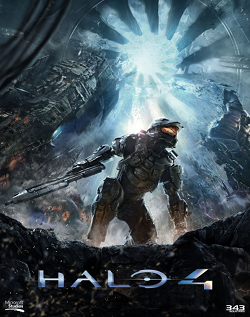
 When Bungie’s seminal Halo
trilogy came to a trembling conclusion in 2007, it was pretty clear that no
one had actually ‘finished the
fight’; as anyone who watched the Legendary ending could have told you. This
return of Halo could be down to the
fact that it is one of the best loved console franchises around, or, more
cynically (or realistically) it might be because a big sleazy corporation like
Microsoft isn’t going to let a cash cow as hefty as Halo go to slaughter. Halo returns this month for a fourth
instalment, but is it more Jaws: The Revenge than A New Hope?
In fact, speaking of movie comparisons, you’ll remember Halo 3 ended in a way remarkably similar
to Aliens, with the baddies defeated,
for the moment at least, and Master Chief sealed up in a cryo-chamber, slipping
his A.I girlfriend the immortal line “Wake
me, when you need me”. Though you get the feeling this was more aimed at
the newly formed Microsoft subsidiary, 343 Industries, who apparently decided,
some five years later, that November 2012 was the right time to wake up their
golden boy. Halo 4 was only going to start in one way; a rude awakening.
Thankfully the awakening for Master Chief in Halo 4 isn’t quite as rude as Ripley’s in Alien 3 (Discovering your child companion is dead, that you have crash-landed
on a prison planet, and that you may or may not have been unconsciously impregnated
by a parasitic life-form). The first important thing we learn is that the
Covenant return as antagonists; a tad disappointing considering we’ve been
fighting Covenant since 2001. However after a couple of levels we are
introduced to a new and interesting foe, machine-humanoid types, the
Prometheans. They manifest in varying forms, from the towering Knights to the swarming
Crawlers, and some infuriating little hover- jet robots, who effectively return
to the series all the infuriating qualities of the Huragok, without any of the
cuddliness. These new enemies come with some new wizz-bangs, but more than any
of the prior instalments there has been a definite move to standardise the
weapons on offer. This can be a little frustrating at times, since though there
are shiny new Forerunner boom sticks on offer, most of them feel samey. The
inclusion of both the Battle Rifle and the DMR proves a wise choice, but they
seem almost exactly the same in range and effect as both the Carbine and the
Light Rifle. Similarly the tried and tested Assault Rifle feels identical to
the Covenant Storm Rifle and the Suppressor. This is rather disheartening after
the eclectic mix offered in Halo: Reach.
Still, that isn’t to say the weapons on offer aren’t sufficient; there are some
resounding successes among the new additions. The Sticky Detonator proves all
sorts of fun, and the blocky SAW gun makes you feel like Metal Gear Rex on a night
out in Plymouth.
This new look is reaffirmed by a story that is gratifyingly
dark and thought-provoking. It is clear
what the greatest new development in the series is; storytelling. That isn’t to
say the previous trilogy wasn’t gripping, involving and satisfying, but it was
a space opera; an all encompassing, galaxy spanning tale of good and evil. Halo 4 is a deeply personal tale, and,
boiled down to its bare bones, it’s a story of one guy moving heaven and earth
to help out a friend in need. Cortana, series stalwart and all around
hell-of-a-gal, is beginning to verge on a state of A.I insanity, ‘rampancy’,
after the damage she sustained at the hands of the Gravemind in Halo 3, and as she surpasses the limits
imposed an artificial life. The original series saw Cortana as a sure-handed AI
counterpart who knew everything, told you where to go and threw out quips for
good measure. Now it’s John 117 who must prop up his failing construct, as she
becomes increasingly divorced from reality, and morality. She gets you into
very hot water more than once. However things never stray too far into
character study territory, and there is an accompanying plot thread that delves
deep into the unplumbed depths the Halo mythos,
and finally shedding some light on the mysterious Forerunners, long-extinct
creators of the Halo rings. There are plenty of big words batted about, and
generally you get the feeling that the first Halo was made as a bit of fun when they chucked a bunch of clumsy
sci-fi terms together, and now the poor buggers at 343 have to try and mesh it
into a wider story. Still, they do an admirable job, and yet again the entire
human race is in danger, with a doom-stricken tale that echoes of Commander
Sheppard’s struggle against The Reapers in the Mass Effect trilogy, and draws comparisons to Chariots of the Gods (as did this year’s other sci-fi epic, Prometheus) in its man-meets-maker revelations.
Furthermore, Halo 4’s
audio suite is totally new, with all of the guns, vehicles, and sound effects
being newly recorded and produced. This new gloss to the old elements of the
game is highly satisfying; for the first time since Halo: CE the Assault Rifle sounds like a real piece of work.
Similarly the toned down clackidy clack of
the Magnum fits the little gun perfectly, and the Plasma Pistol, long derided
as less use than Ann Widdecombe at a three-legged race, finally has teeth. All
good things. Martin O’Donnell’s soundtracking of the previous five adventures
was masterful; emotive, epic, powerful, and often moving, but he has a keen
replacement in Neil Davidge, renowned for his work with Trip-pioneers Massive Attack. He mixes strings with
subtle electronic bleeps and bloops, and though he retains some of the classic
themes, which helps to make the game feel tied into the wider story, he knows
where to draw the line. From the second you see a menu screen that isn’t
accompanied by the classic choral chanting from the games of old, we know this
is a new, distinct adventure. Similarly
the script is smart and sharp, with plenty of meaningful interchange between
the ailing A.I Cortana and Master Chief, backed up by excellent voice-acting
from Jen Taylor and Steve Downes.
Of course for some, Halo
means only one thing; multiplayer. Multiplayer returns in 4 as part of Infinity. This includes War Games, the new title for the
competitive multiplayer component. The online is no great departure for the
series, but classic aspects have been masterfully matched with newer
innovations. The introduction of
loadouts may turn some purists to proclaim Halo
has ‘done a Call of Duty’, but you
have to remember how successful the mechanic was in that series, and it feels
right here. It is gratifying having a greater ability to modify your setup in
online games. There are limits, necessarily; you won’t be spawning with two
rocket launchers anytime soon, but it is useful to be able to pick a range
weapon or a close quarter’s option. The
customisation options for your characters appearance, are greater in variety
but shallower in style, and many of the options seem almost identical, or are
otherwise just a bit wank; with many of the Spartan armour variants hopelessly
intermingled with far-flung anime styles, which don’t bode very well at all.
This is a shame after the consistently gratifying range available in Halo: Reach. Still, this is a minor
issue. The multiplayer component is absolutely fantastic. Every map has great
potential, and the various vehicles are as gratifying as ever. The introduction
of a perk system goes down well, with various options that may be bolstered
onto your class.
Another new introduction is the ‘Ordnance’ unlocks,
essentially a reworking of another successful CoD function, care packages. When you ratchet up enough points you
are given the option of three different benefits, which then thunder down in a
little canister in front of you. It’s an excellent inclusion, keeping up the
pace and making it easier to lay hands on better kit. Overall the multiplayer component is as
arresting as ever, with added pace thanks to the automatic inclusion of a
sprint function (Previously Halo’s
Spartan super-soldiers could only manage a casual jog, or, in Reach, they could run, but only for
about five seconds, before presumably collapsing with a stitch) This is backed
up with Forge, Theatre settings, and an episodic Spartan Ops mode, which is
updated with free content week on week.
Currently it doesn’t stand up to much but hopefully the later episodes
will prove more taxing. However you can’t help but lament the loss of the
excellent Firefight mode, although it had never quite been done justice since ODST anyhow.
Science-fiction, as a genre is derided for poor
characterisation, wobbly storytelling and a tendency to delve into the silly;
its saving grace is excellent art design. And credence must really be paid to
the art design here; the reworking and tweaking of the classic Halo aesthetic is genius. It’s clear
this is a new title, but its roots are buried deep in the rich soils of past
adventures. Does the world need a new Halo
trilogy? Curiously, the answer is probably no. None of the games can surely
have the same kind of impact their forebears did back in the day; the birth of
console multiplayer proper, creating clever sci-fi, and outselling Hollywood,
are just a few of Bungie’s achievements.
But regardless of that, many people are very glad to see it back. Things
could get very interesting, and the promise of 5 being a ‘much darker’ tale, sounds equally intriguing. It is
exciting so see where 343 take their stoic protagonist next, as they finally
begin to open up Master Chief to woe, turmoil, and loss. As it is, their first
instalment combines big blockbuster entertainment, and fiendishly consistent
online offerings, with a convoluted and complex core of clever sci-fi. There
are plenty of references from the greats of modern sci-fi, from the paranoia of
2001: A Space Odyssey, the intrigue and
danger of Prometheus, and the camerawork of
JJ Abrams. A fresh and inspired entry into the series, and a highly effective
new beginning.
